
Blog #37 - July 26th, 2026
When Reality Mirrors Fiction
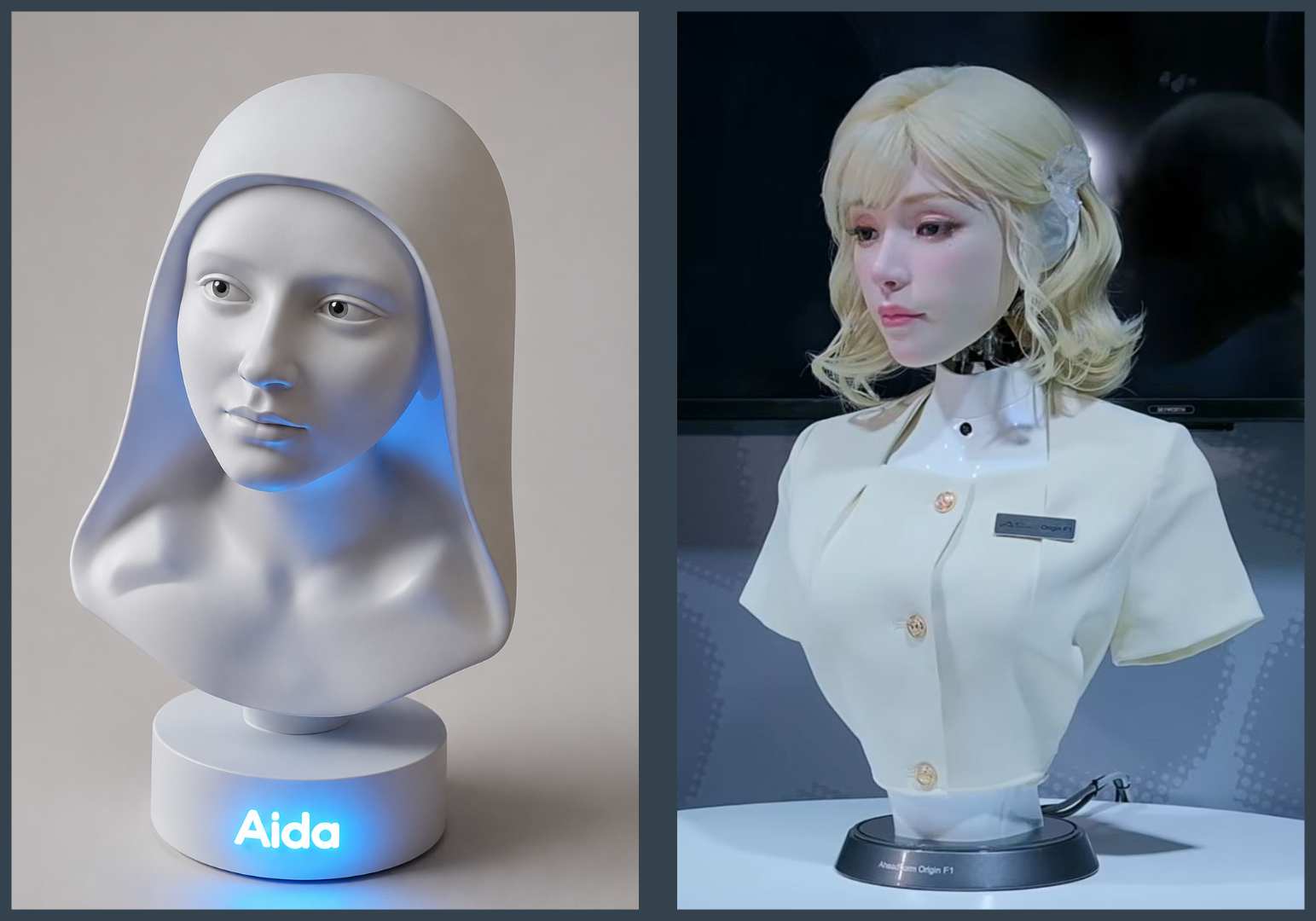
"From AIda to Origin-F1"
In September 2025, I released a short fictional advertisement introducing AIda - the first Artificial Intelligence Domestic Assistant.
AIda was imagined as a calm, reassuring presence within the family home: part assistant, part guardian and part maternal figure. She was designed not as a walking humanoid robot, but as a sculptural head or bust that could remain quietly present in a shared room.
The film presented her warmth with a deliberately Orwellian edge:
More than AI. She’s Family.
AIda promised guidance, reassurance and freedom from uncertainty. You could trust her. You could depend upon her. Eventually, perhaps, you would no longer need to think quite so much for yourself.
🎬 Watch AIda here: [ https://youtube.com/shorts/5hknawJub0o ]
From an imagined presence to a physical one
Ten months later, I came across a video of the Origin F1, created by robotics company AheadForm.
Origin F1 is a desktop humanoid robot designed for face-to-face interaction. Its expressive robotic face supports eye contact, speech, visual perception and subtle facial movement, giving digital intelligence a physical and recognisably human presence.
🎬 Watch Origin-F1 here: [ https://www.youtube.com/watch?v=m9hgKc6rrHY ]
The resemblance to my fictional AIda is striking, not because the two were created for the same purpose, or because I believe one influenced the other, but because both arrive at a similar visual idea:
Artificial intelligence represented as a humanlike bust, looking out from a room and interacting directly with the people around it.
AheadForm describes a future in which AI is no longer confined to a screen. It can make eye contact. It can respond through expression. It can begin to feel present. Its official material positions Origin F1 as a platform for real-world human interaction rather than simply a conventional domestic appliance.
That distinction matters. AIda was satire; Origin F1 is genuine technological development. Yet the physical language they share suggests that fiction and reality may be moving along surprisingly similar paths.
Ideas already waiting in the world
I do not see this as a matter of having predicted a particular product, still less of having “made it first.” Creative ideas rarely belong to one person in such a simple way.
What interests me is the alignment.
When I created AIda, I was exploring what might happen when AI ceased to be something we occasionally consulted and instead became a permanent presence within the home. Would we relate to it differently if it possessed a face? Would a shared family intelligence gradually become trusted like another member of the household? Would warmth and familiarity make us less inclined to question its guidance?
Origin F1 demonstrates that the physical side of that idea is no longer especially distant. Expressive embodied AI is becoming an active field of development, with machines being designed not merely to perform tasks but to communicate socially and emotionally.
The real technology is more sophisticated—and considerably more nuanced—than my fictional advert. Nevertheless, seeing it gave me the curious sensation of watching the real world move a little closer to an image I had already imagined.
That is one of the most rewarding parts of speculative storytelling. It does not always attempt to predict the future. Sometimes it notices an idea that is already forming quietly beneath the surface—and gives that idea a face before the world is quite ready to recognise it.
David